Water points
RFID readers at the troughs record which animals come to drink.
Drone cattle counting for feedlots
No expensive RFID tags, no pen entry, no guesswork.
Live on a 60-pen feedlot in the North West
Counted in under an hour, from take-off to per-pen numbers and video.
Within 1 head per pen on average.
The same count by hand takes 4 people a full day, on foot among the cattle.
Inside one flight
Real video from our pilot feedlot. Switch between what the drone films, what the AI sees, and what you get on your dashboard.
The model outlines every animal, finds the fences on both sides of the pen, and tracks each animal by ID so none is counted twice.
The dashboard
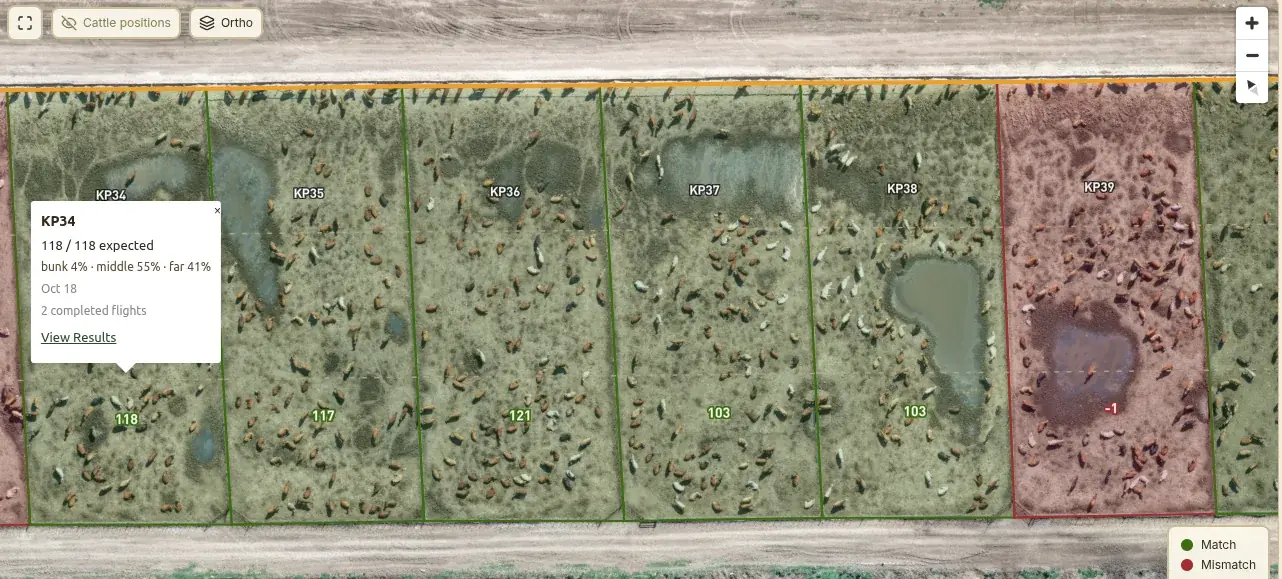
Every pen shows its count against your books, green for a match and red where it's off. Turn on cattle positions and you see each animal exactly where it stood during the flight.


Real dashboard from our pilot feedlotDrag to compare
Drone mapping
Satellite images are low resolution and can be months old. Each Heelr flight builds a fresh, high-resolution map of your pens, so you can see every animal, water point and bunk as they are right now.
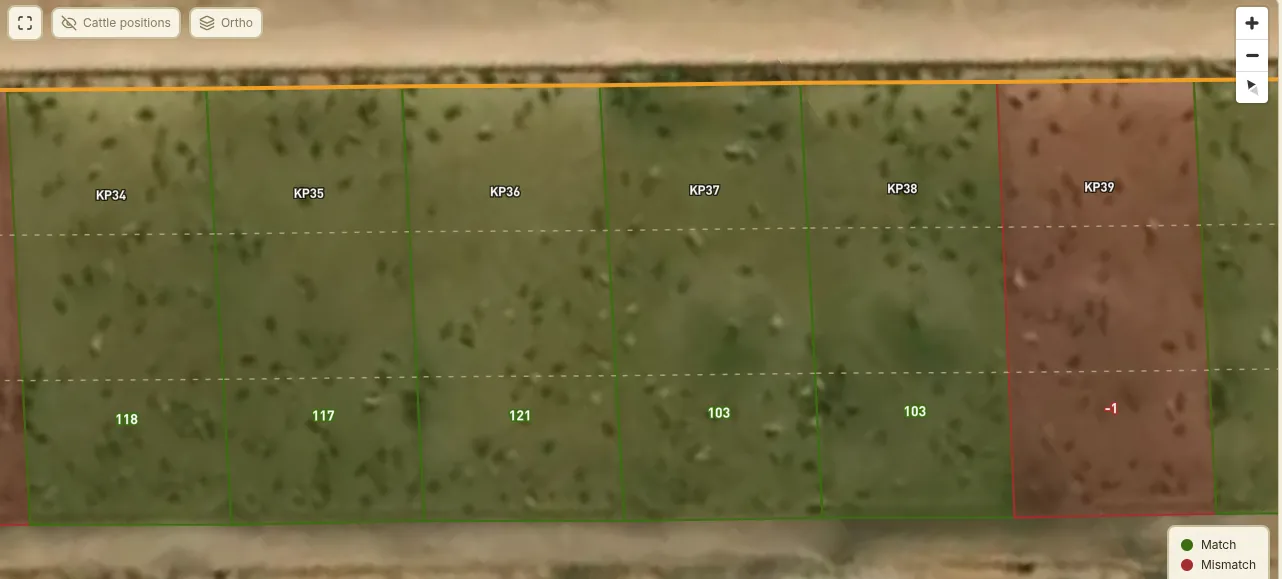 Satellite image
Heelr drone map
Same six pens, drone vs satelliteDrag to compare
Inventory
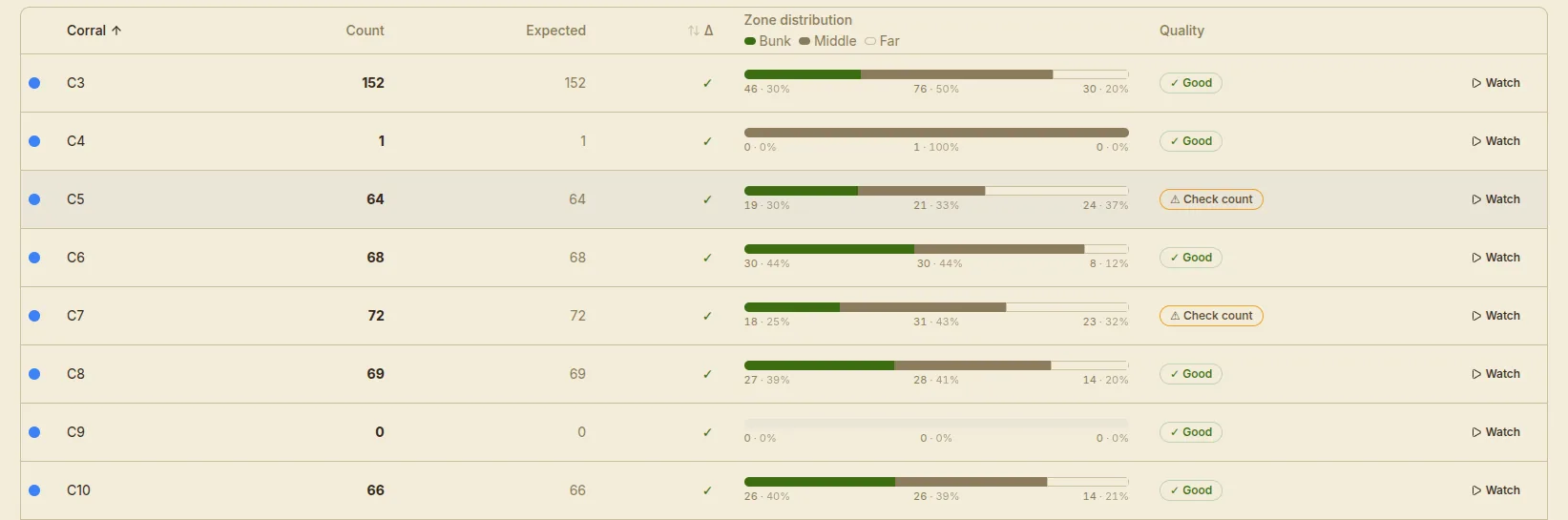
Each flight gives you a per-pen inventory next to your expected headcount. A missing or extra animal shows up straight away, not at the next manual audit.
Bunk management
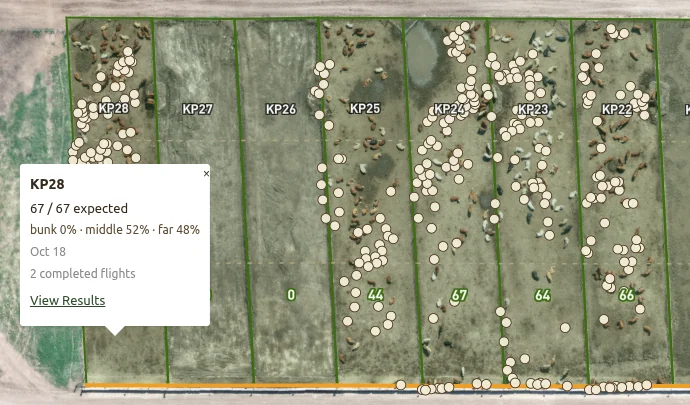
The same flight maps every animal. See the share of cattle at the bunk, in the middle and at the back of each pen, with every animal's position on a satellite view of your farm.
Audit trail
Every flight's counts and every pen's video are stored. Look back at any date and you have an exact, visual audit record of what was in each pen.
| Flight | Count | Difference |
|---|---|---|
| Flight 10Oct 21, 2026 | 2,931 / 2,946 | -15 · -0.5% |
| Flight 9Oct 13, 2026 | 1,736 / 1,740 | -4 · -0.2% |
| Flight 8Oct 6, 2026 | 3,355 / 3,374 | -19 · -0.6% |
| Flight 7Sep 29, 2026 | 1,221 / 1,215 | +6 · +0.5% |
| Flight 6Sep 21, 2026 | 2,932 / 2,951 | -19 · -0.6% |
| Flight 5Sep 14, 2026 | 687 / 682 | +5 · +0.7% |
| Flight 4Sep 6, 2026 | 1,508 / 1,513 | -5 · -0.3% |
| Flight 3Aug 30, 2026 | 1,512 / 1,513 | -1 · -0.1% |
| Flight 2Aug 22, 2026 | 1,556 / 1,563 | -7 · -0.4% |
| Flight 1Aug 14, 2026 | 1,694 / 1,683 | +11 · +0.7% |
How it works
Your pens are mapped once. Starting a count after that is one tap. No pilot skills needed.
The drone takes off, flies a straight pass down every pen with the camera pointed straight down, and lands where it started.
The footage uploads and our model counts each animal and assigns it to the pen it stands in.
Per-pen inventory against expected counts, cattle positions on your satellite map, and video of each pen.
Heelr vs a manual count
| Measure | Heelr | Manual count |
|---|---|---|
| 5,000 head | Under 1 hour | A full day |
| People needed | One person taps start. No pilot skills needed | 4 people |
| Entering pens | Never | Every pen |
| Accuracy | >99% accurate, within 1 head per pen on average | Varies with crew and conditions |
| Evidence | Video of every pen, kept for every flight | A tally sheet |
| Bunk insight | Share of cattle at the bunk, middle and back | A walk-past impression |
What counting costs you
See how much time your team spends counting by hand, and what a miscount is worth at your prices.
Uses only the numbers you enter. Nothing is sent or saved.
In development
Counting never needs a tag. For feedlots that already tag their cattle, we’re building RFID readers at water points, feed bunks and loading docks, in the same dashboard.
RFID readers at the troughs record which animals come to drink.
RFID at the bunk adds individual feeding activity to the pen-level view from the air.
Every animal read in and out at loading, so arrivals and dispatches match the count.
Questions farmers ask
No. Settled cattle ignore it. New intake may notice it and move around at first, but they get used to it quickly. It flies one straight pass down each pen, 15 to 45 metres up depending on the pen's width, and nobody has to walk in among the cattle.
Heelr flies a DJI Air 3S, which is rated for winds up to 12 m/s (about 43 km/h) and temperatures from −10 °C to 40 °C, with up to 45 minutes of flight per battery. If the wind gets too strong, the drone returns home and lands by itself. It can't fly in rain, so you fly once it clears.
Yes. Our AI model is trained on cattle of every colour, standing or lying down, and bunched together at the bunk.
After the drone lands, the footage uploads over your farm Wi-Fi and our AI counts every pen. If your internet is slow, you can buy a local hardware setup that only needs about 8 Mbps. Get in touch and we’ll tell you more.
Either way works: type the expected headcount for each pen into the dashboard, or import it from a spreadsheet. Every flight is checked against it.
Every pen has its own video from the flight. Open it, watch the pass and check the animals yourself. Pens that need a second look are flagged with “Check count”.
Your farm owns it. You buy a DJI Air 3S Fly More Combo from any certified DJI retailer or Takealot, and DJI handles any hardware warranty and repairs.
Your counts, videos and maps belong to your feedlot, and they’re kept on secure cloud storage.
Pricing depends on the size of your feedlot. Get in touch and we’ll send you a quote.
Get in touch
Heelr is built by farmers, for farmers. Feedlot managers: we'll fly a demo count on your pens.